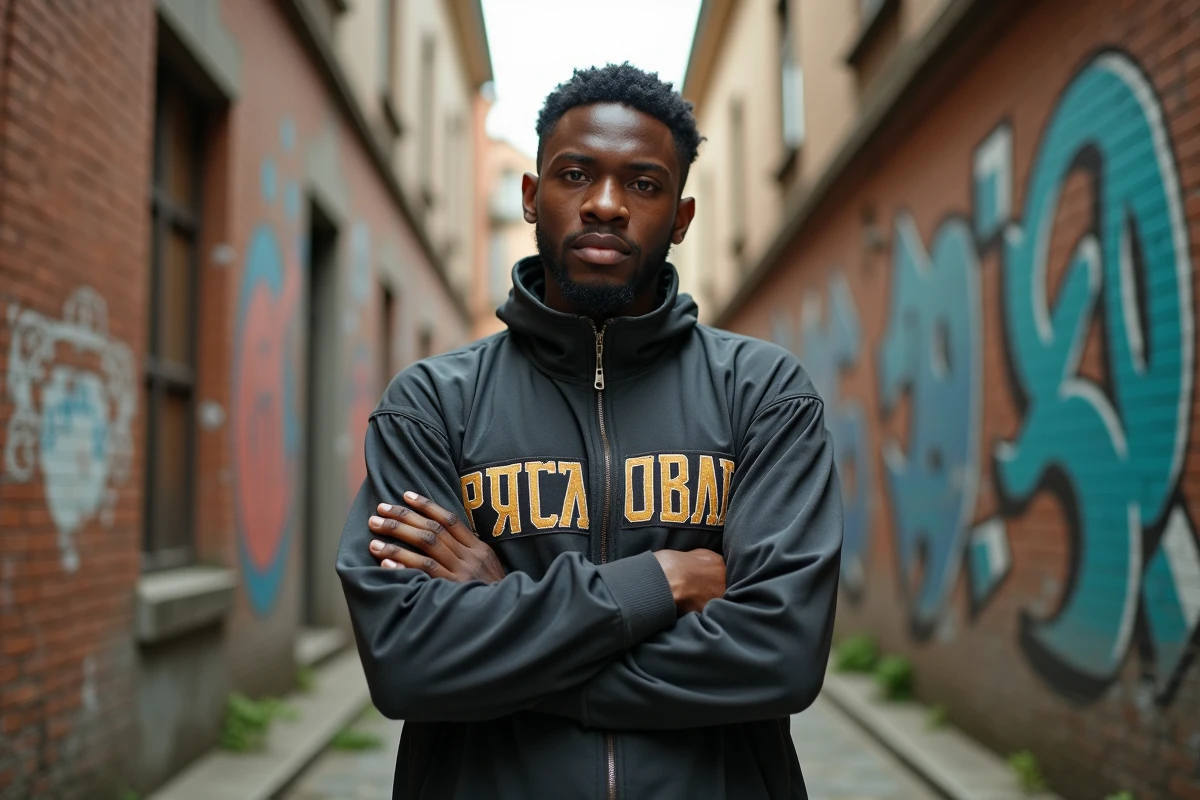
Tovaritch is a unique case study in French rap. Born to a Franco-Polish mother and a Russian father, he arrived in France at the age of five and grew up in the 93, in Seine-Saint-Denis. His stage name, derived from the Russian word товарищ (tovarishch, “comrade”), is not an aesthetic choice: it immediately anchors a post-Soviet identity in a musical landscape where no one occupied this niche.
Товарищ: an alias as an identity marker in French rap
The choice of a name in Cyrillic is not trivial in terms of artistic positioning. Tovaritch has repeatedly explained that the alias needed to be immediately recognizable as Russian, not just “exotic.” This approach distinguishes him from rappers who borrow international references for sound.
The family environment played a structuring role. Russian was spoken at home, cultural codes inherited from the USSR and post-Soviet Russia, and historical references passed down through parental education. These elements directly feed into his writing. The recurring mentions of the Kalashnikov, the KGB, or the red flag in his lyrics function as identity markers, not as gangsta gimmicks.
To delve deeper into the journey and origins of rapper Tovaritch, one must trace back to this dual culture that permeates every project, from the artistic direction of the music videos to the choice of instrumentals.
Bratva series and the construction of a trap universe with Soviet references
In 2019, Tovaritch launched a series of freestyles on YouTube titled Bratva (mafia in Russian). The format is raw: wild clips, trap production, voice saturated with rage. The series lays the foundations of a coherent universe where each track reinforces the previous one.
The approach is distinguished by the convergence of content and form. The trap instrumentals, dominated by heavy bass and fast hi-hats, serve a message that goes beyond mere stylistic exercise. Tovaritch uses his tracks to take a stance on current events, adding a rare editorial dimension to the freestyle format.
The series concluded in May 2020 with Bratva X Pushka. The first mixtape, titled Bratva, was released on June 26, 2020. The transition from freestyle to mixtape marks a shift towards a more developed project structure, without abandoning the raw aesthetic that built the initial audience.
- Bratva (2019): series of YouTube freestyles, clips shot with no apparent budget, strong visual identity (Cyrillic typography, Soviet imagery)
- Bratva X Pushka (May 2020): final episode of the series, serving as a transition to the mixtape format
- Mixtape Bratva (June 2020): first structured project, consolidation of the sound and visual universe
- Baba Yaga 2: recent project available on streaming platforms, marking an increase in production
Media visibility: Rentre dans le cercle and atypical positioning
The invitation of Fianso to Rentre dans le cercle marked a turning point in terms of exposure. This format, which acts as an accelerator of notoriety in French rap, allowed Tovaritch to reach an audience far beyond his YouTube base.
The peculiarity lies in the fact that Tovaritch does not fit any classic archetype of the Parisian suburban rapper. The 93, a territory heavily represented in French rap, has never produced a Franco-Russian profile that so openly claims Soviet references. This cultural uniqueness serves as a competitive advantage in a saturated market where differentiation has become a matter of survival.
His YouTube channel has over 491,000 subscribers, with a catalog of 42 videos. The subscriber/video ratio indicates a high retention rate, a sign that the artistic universe holds the audience beyond mere buzz.
War in Ukraine and the evolution of Tovaritch’s political discourse
Since the outbreak of the conflict in Ukraine in 2022, Tovaritch has publicly evolved his position. In an interview for Clique TV in March 2022, he stated that he considers Ukrainians “like our brothers” and refused to be politically instrumentalized.
This statement is significant for an artist whose entire communication is based on a strong Russian identity. The distinction he makes between the Russian people and the Russian political power reflects a maturity of discourse that is rare in French rap, where geopolitical stances remain infrequent and often superficial.
We observe here an interesting mechanism: the artist separates cultural heritage from political positioning. The Soviet references in the lyrics do not disappear, but they now coexist with a discourse of solidarity towards Ukraine, creating a narrative tension that enriches the artistic project rather than weakening it.
Artistic direction and visual codes in Tovaritch’s clips
The visual coherence of Tovaritch’s projects deserves separate analysis. The Cyrillic typography, cold tones, urban settings from the 93 mixed with Russian symbols create an immediately identifiable graphic identity.
This artistic direction is not limited to the clips. The covers, the communication visuals on social media, and even the titles of the projects (Bratva, Baba Yaga, Sovietskiy, Mikhailov) contribute to a total storytelling. Each element refers back to the same referential universe.
- Bratva and Sovietskiy: vocabulary directly borrowed from the Russian lexicon, anchoring each project in narrative continuity
- Baba Yaga: figure from Slavic folklore, a choice that broadens the referential field beyond just the mafia register
- Mikhailov: Russian surname used as a project title, reinforcing the personal and autobiographical dimension
Tovaritch has built an artistic territory over a few years that no one else occupies in French rap. The strength of this universe relies less on a gimmick than on a real biographical anchoring, making the proposition difficult to replicate and, consequently, sustainable.