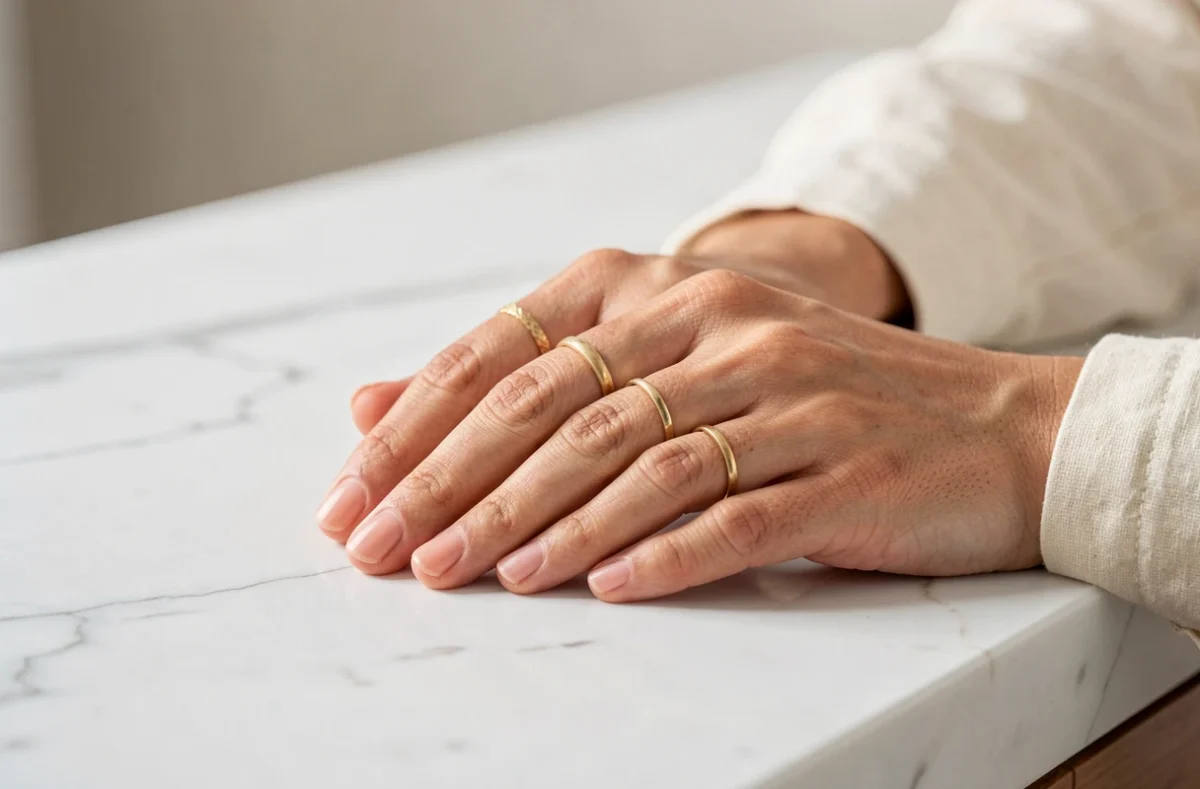
Choosing the finger on which to wear a ring is not just about symbolism. The width of the ring, the shape of the hand, the time of day when the jewelry is worn, and even the dominant hand affect the visual appearance and comfort experienced. This article compares the practical criteria often overlooked in guides that focus solely on cultural meanings.
Comfort and Fit: The Factor That Symbolism Doesn’t Address
Most articles on ring wearing detail the significance of each finger. They overlook a crucial parameter: the knuckle is often wider than the base of the finger. A ring should pass over the knuckle with slight resistance and then remain stable once in place.
Measuring only at the base of the finger leads to two mistakes. Either the ring slips and rotates constantly, or it gets stuck at the knuckle and becomes difficult to remove.
According to Mon Bijoutier d’Ici, heat, physical effort, and cold notably change finger size. The measurement is more reliable when taken at room temperature, preferably at the end of the day, and never right after exercise. This parameter applies to all fingers, from the thumb to the pinky.
To delve deeper into the selection criteria finger by finger, Madame Pervenche’s ring guide details each option with its morphological constraints.

Comparison Table: Which Finger for Which Type of Ring
The table below correlates the chosen finger with the suitable type of ring, daily comfort, and practical constraints to anticipate.
| Finger | Suitable Type of Ring | Daily Comfort | Main Constraint |
|---|---|---|---|
| Thumb | Wide ring, thick band | Medium (possible discomfort when gripping) | A thin ring goes unnoticed; prefer a bold band |
| Index | Signet ring, ring with visible design | Good (mobile finger, little friction) | Dominant hand may be bulkier; check the size of both hands |
| Middle | Medium to wide ring | Variable (may hinder writing) | The knuckle is often the most pronounced on this finger |
| Ring | Wedding band, solitaire, thin ring | Very good (seldom used in gestures) | Possible confusion with engagement if worn on the left |
| Pinky | Thin ring, signet ring | Good (little interference) | Narrow finger; wide rings visually unbalance the hand |
This table highlights that comfort depends as much on the finger as on the width of the ring. A signet ring on the middle finger of the dominant hand may hinder writing while remaining perfectly stable on the index.
Dominant Hand or Non-Dominant Hand: The Differences to Know
The fingers of the dominant hand are slightly bulkier than those of the other hand. A ring fitted to the left ring finger may not necessarily fit the right ring finger. This difference, even if minimal, can make a piece of jewelry uncomfortable for an entire day.
In practice, wearing a ring on the non-dominant hand reduces the risks of impact and wear on the metal. For rings made of steel or resin, resistance to friction is higher, but fit remains the primary criterion.
- Measure each finger separately on the hand where the ring will be worn, not on the other hand for convenience
- Prefer the end of the day to take the measurement, when the fingers have reached their maximum volume
- Avoid measuring after prolonged exposure to cold or just after intense physical effort
The size must be taken on the exact finger and the exact destination hand. A measurement transposed from one finger to another leads to frequent errors.
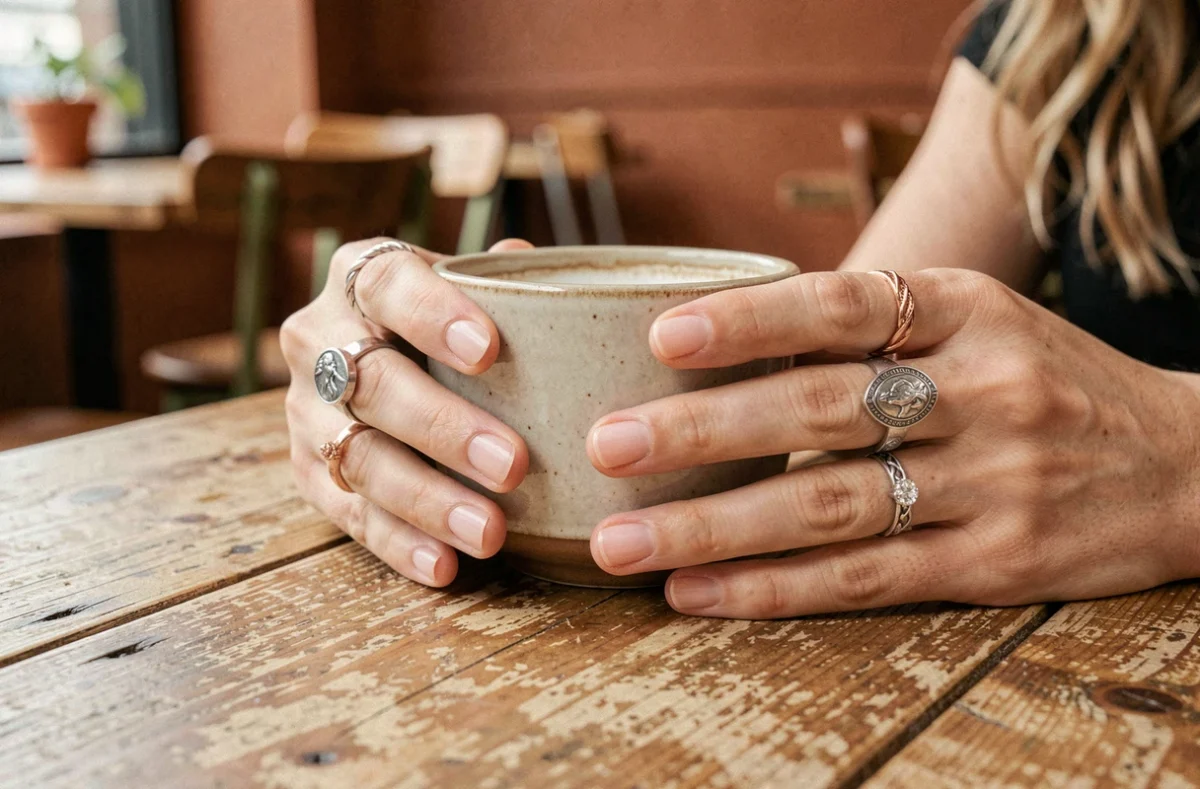
Visual Proportions: Adapting Ring Width to Finger Morphology
A long, slender finger can support wide rings without losing elegance. In contrast, a short, wide finger will appear even more stocky with a massive band. The proportion between the width of the jewelry and the visible length of the finger determines the visual balance of the hand.
Thin rings (less than four millimeters) suit most fingers and lend themselves to stacking, the layering of several bands on the same finger or on adjacent fingers. Rings wider than six millimeters are best worn alone, on a finger that remains proportionate.
Stacking and Accumulation: Which Fingers to Favor
The ring and middle fingers are the most commonly used for stacking multiple rings, as their length allows spacing between the bands without a cluttered effect. The thumb, on the other hand, offers surface area but accumulation there quickly creates a bulky effect that disrupts the silhouette of the hand.
Stacking on the pinky works exclusively with very thin rings. Beyond two bands, the finger appears overloaded and comfort decreases.
Ring on the Finger and Personal Style: What the Choice Reveals
The thumb immediately draws attention. A wide steel band on the thumb projects a bold image. The index finger, historically associated with signet rings and power rings, remains the finger where a ring with a visible design has the most impact.
The left ring finger remains culturally linked to the wedding band in most European countries. Wearing a decorative ring on this finger without the intention of commitment can lead to confusion. The right ring finger, however, does not carry the same symbolic weight in France.
The pinky, often associated with signet rings or family rings, offers a discreet location that does not interfere with daily gestures. For men, it is the finger that best combines visibility and comfort with a small-sized piece of jewelry.
The final choice rests on three intersecting variables: the morphology of the finger, the type of ring considered, and the signal the wearer wishes to send. A wide band on the thumb does not communicate the same message as a solitaire on the ring finger. Checking the fit on the correct finger, on the correct hand, at the right time of day remains the only reliable method to prevent an elegant ring from becoming a piece of jewelry that is ultimately removed.